Closing the Loop in Airport Infrastructure: JFK and TWA Hotel Case Study
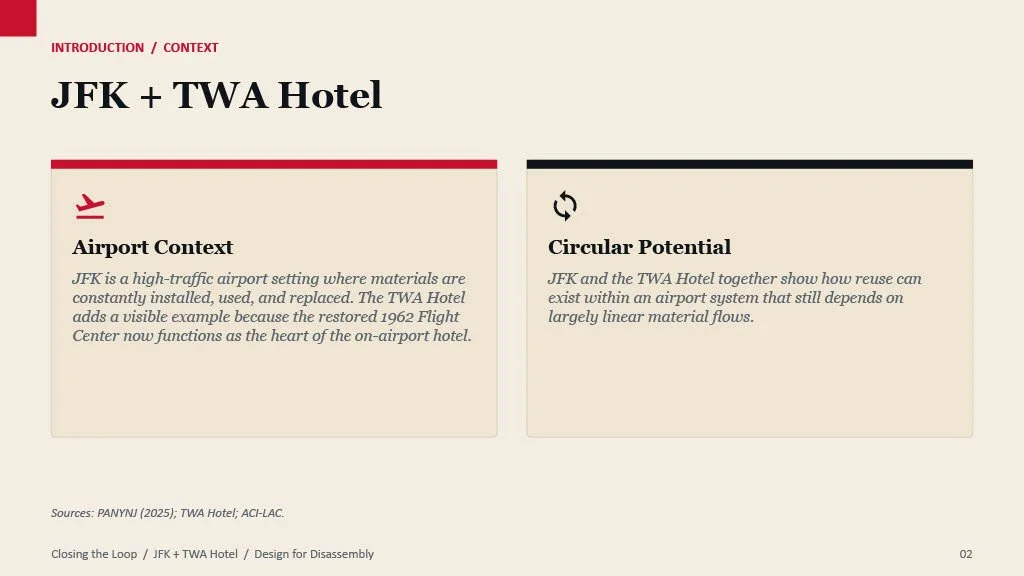
Developed for Circular Economy (PS5470) within Columbia University’s M.S. in Sustainability Management program, this case study examines why circularity stalls in airport infrastructure, tracing how interiors at JFK and the TWA Hotel cycle through repeated installation and replacement while structural systems stay intact.
“JFK Airport and the TWA Hotel illustrate how circularity challenges are not driven by a lack of solutions, but by systemic patterns that prioritize speed, convenience, and short-term performance over long-term material retention. Interiors cycle through repeated installation and replacement, while structural systems remain intact, creating a persistent gap between use and value. Without intervention at the system level, this pattern continues to reinforce itself, making disposal the default rather than recovery.”
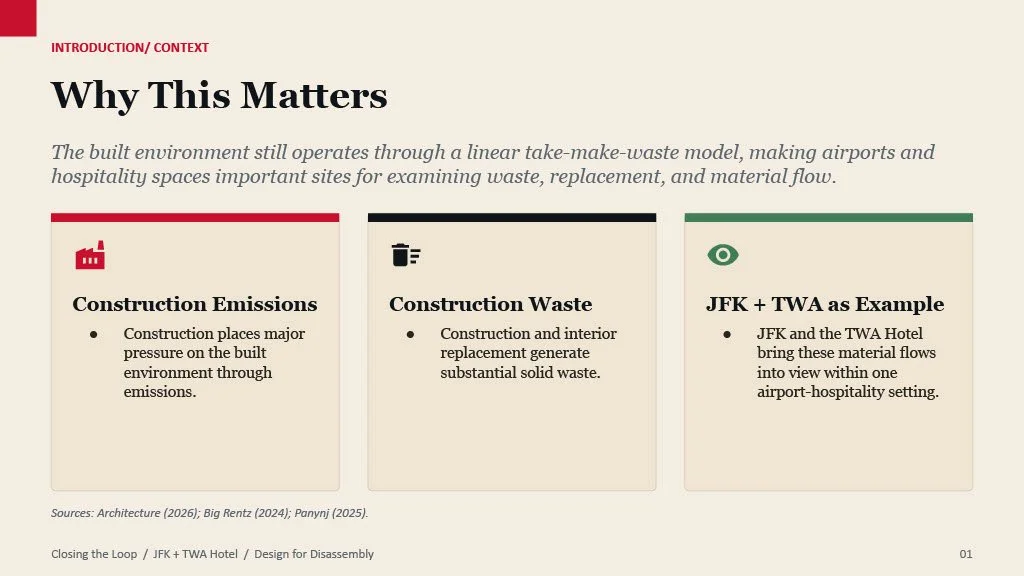
The scale of the problem
Construction accounts for 42% of global CO2 emissions and 30 to 40% of global solid waste, and Li et al. (2025) project that construction's share of global emissions could roughly double by 2050 without intervention. JFK concentrates that flow into one campus, moving 62.6 million passengers a year through terminals under near-continuous renovation.
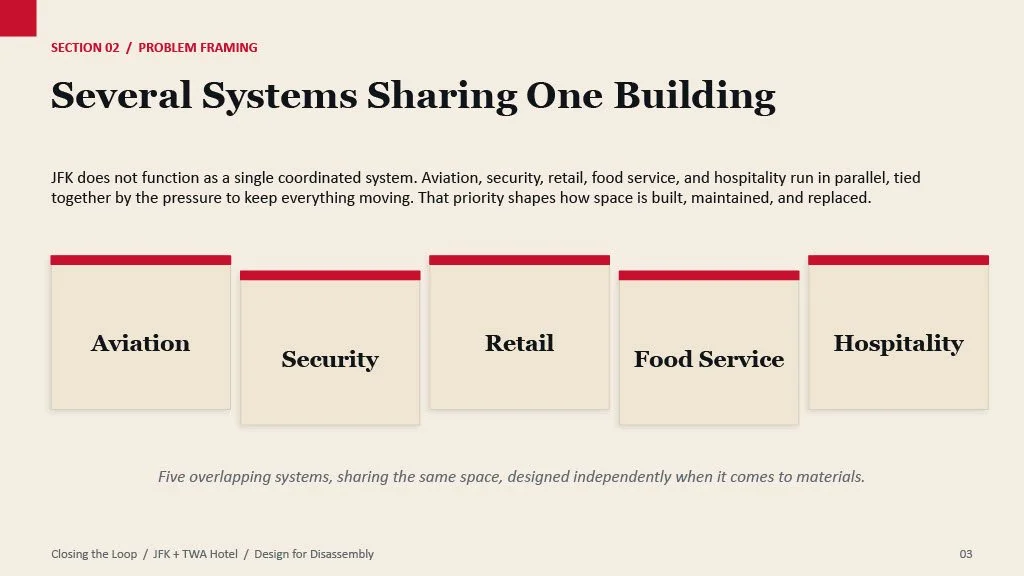
Five systems sharing one building
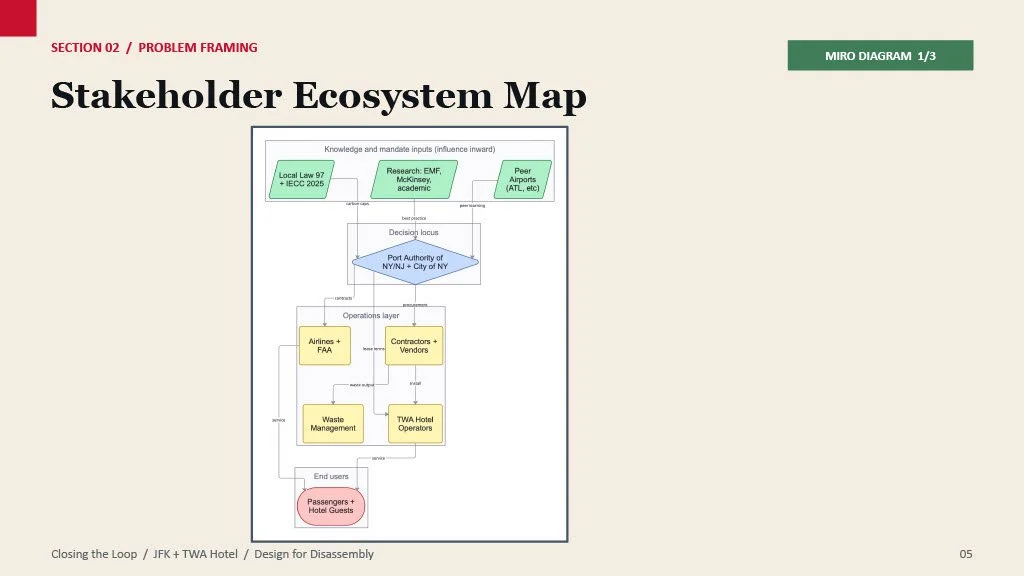
Aviation, security, retail, food service and hospitality run in parallel at JFK, tied together by the pressure to keep everything moving, and that priority shapes how space is built, maintained and replaced.
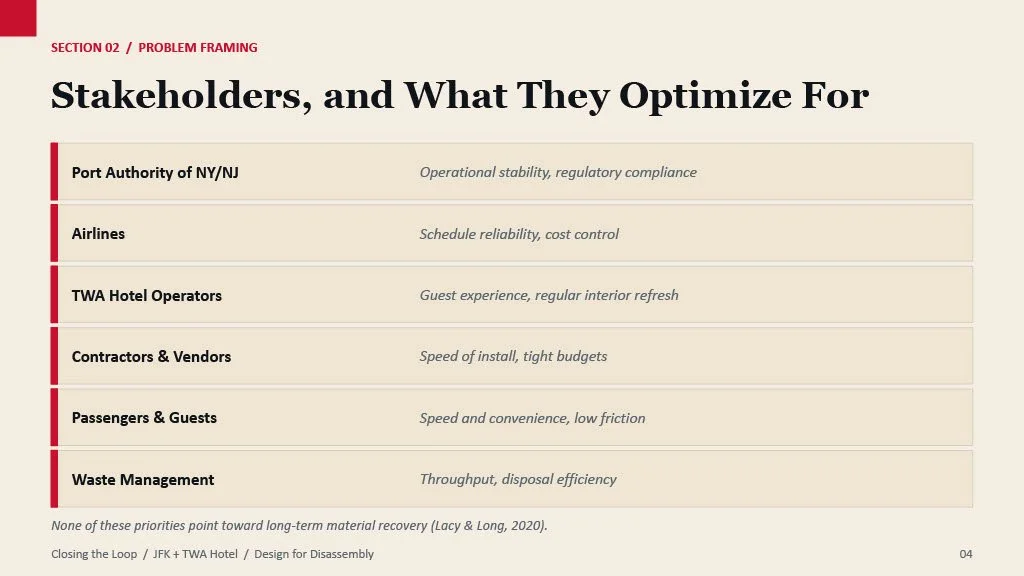
Each actor optimizes for something reasonable, so the Port Authority of New York and New Jersey wants operational stability and regulatory compliance, airlines want schedule reliability and cost control, the TWA Hotel wants guest experience and a regular interior refresh, contractors want speed of install inside tight budgets, and waste handlers want throughput. None of those priorities points toward long-term material recovery.
The loop that keeps itself running
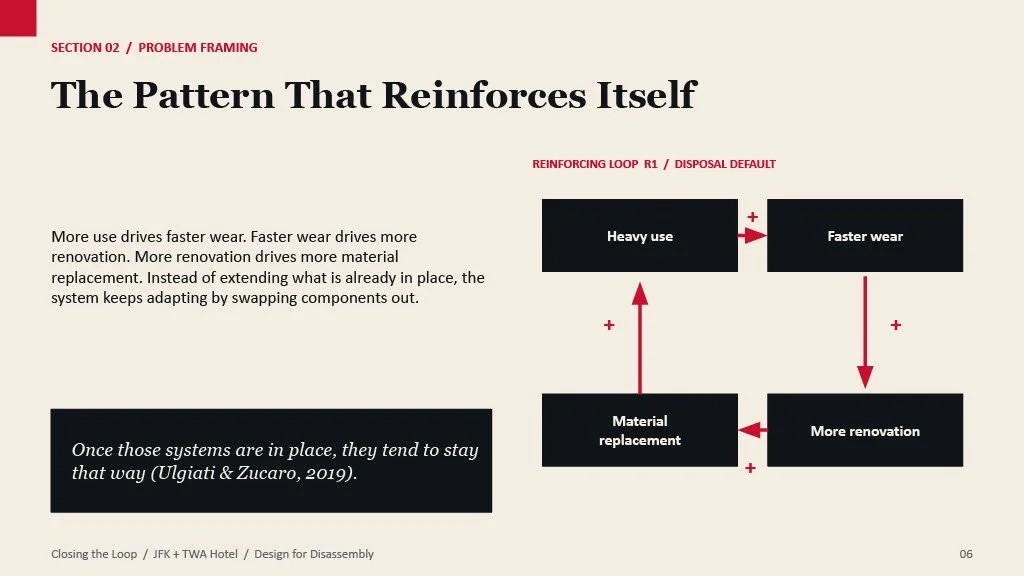
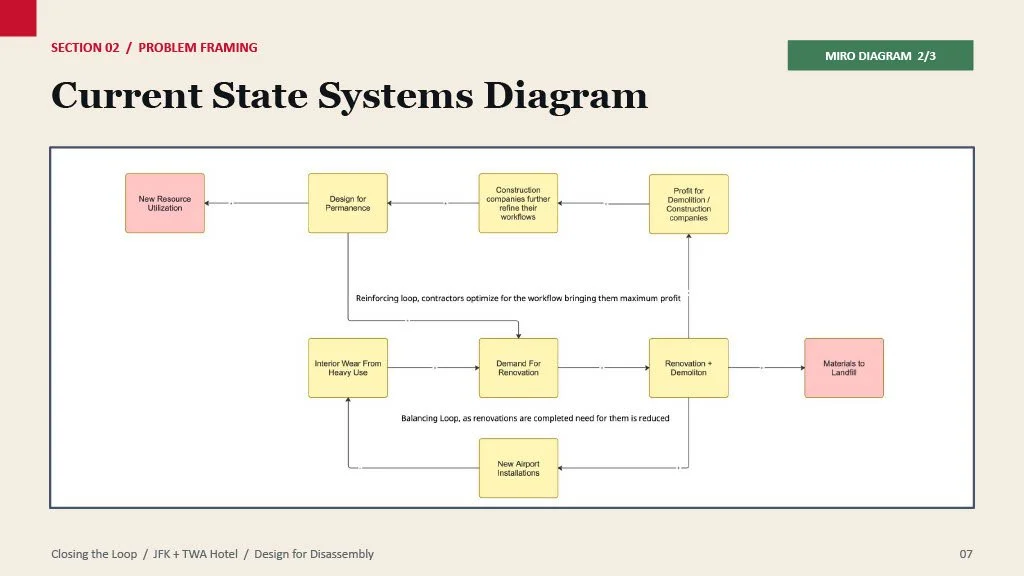
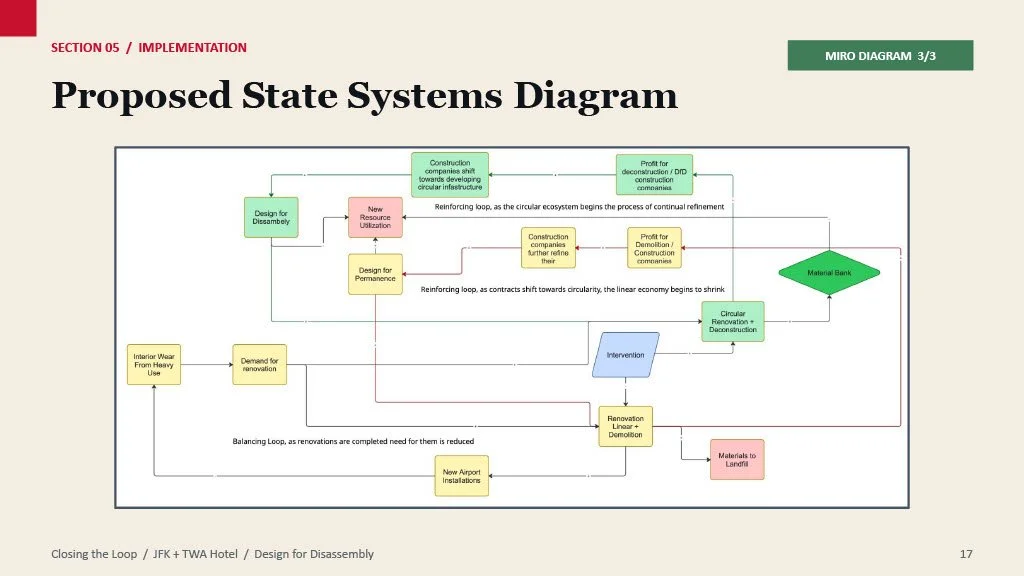
Heavy use drives faster wear, faster wear drives more renovation, and more renovation drives more material replacement. The system adapts by swapping components out instead of extending what is already in place, and once that pattern is established it tends to stay.
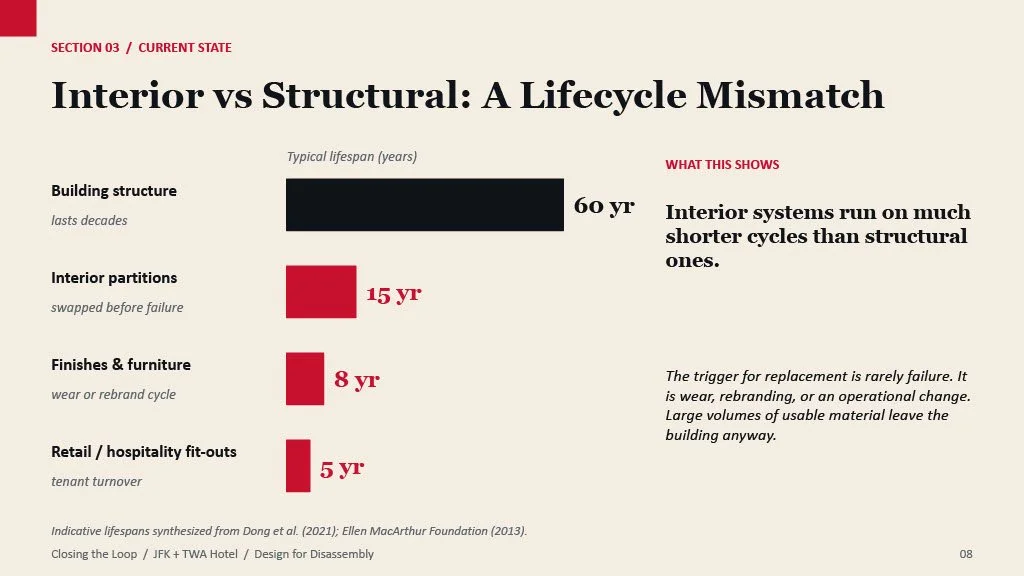
The mismatch underneath it is one of clocks, because building structure lasts around 60 years while interior partitions are swapped at around 15, finishes and furniture at around 8, and retail and hospitality fit-outs at around 5. Replacement is rarely triggered by failure. It is triggered by wear, a rebrand or an operational change, so large volumes of usable material leave the building regardless.
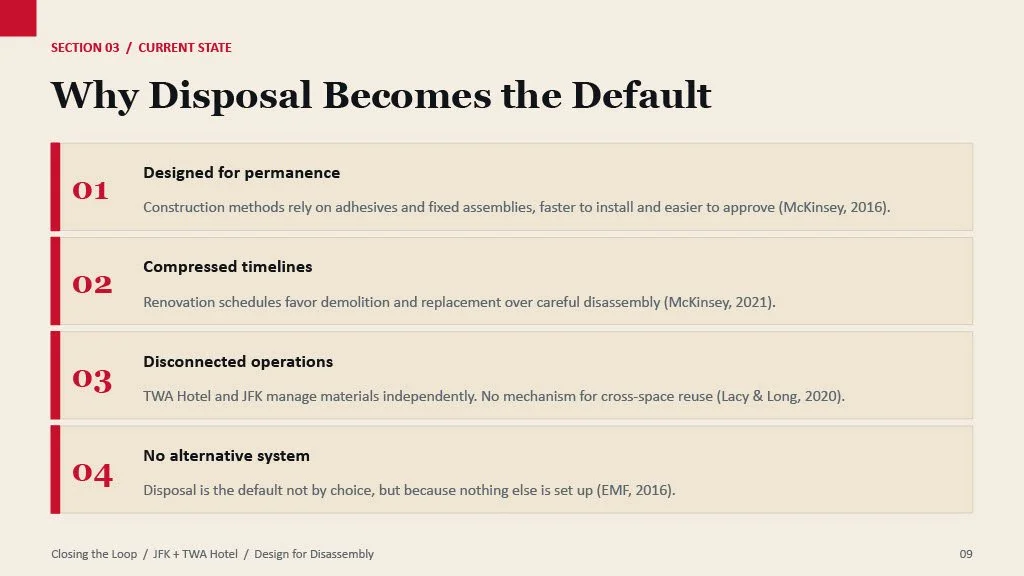
Four things hold the pattern in place: assemblies built with adhesives and fixed connections because they are faster to install and easier to approve, renovation schedules that favor demolition over careful disassembly, JFK and the TWA Hotel managing materials independently with no mechanism for cross-space reuse, and no alternative system for recovered material to enter. Disposal is the default because nothing else has been set up.
The intervention
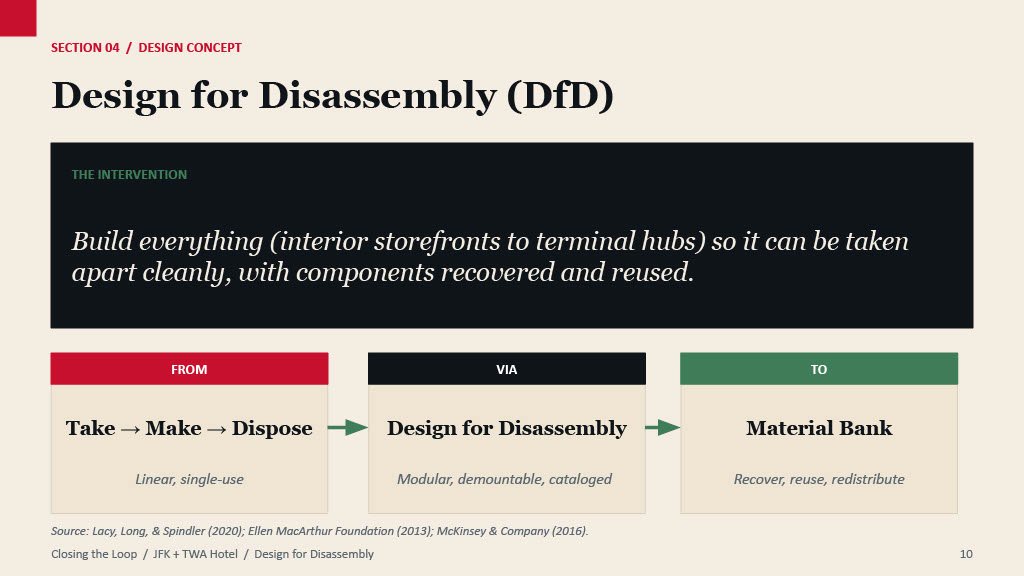
Design for disassembly means specifying interiors, from retail storefronts to gate hubs, so they can be taken apart cleanly and the components recovered, cataloged and reused. Take, make, dispose becomes a material bank.
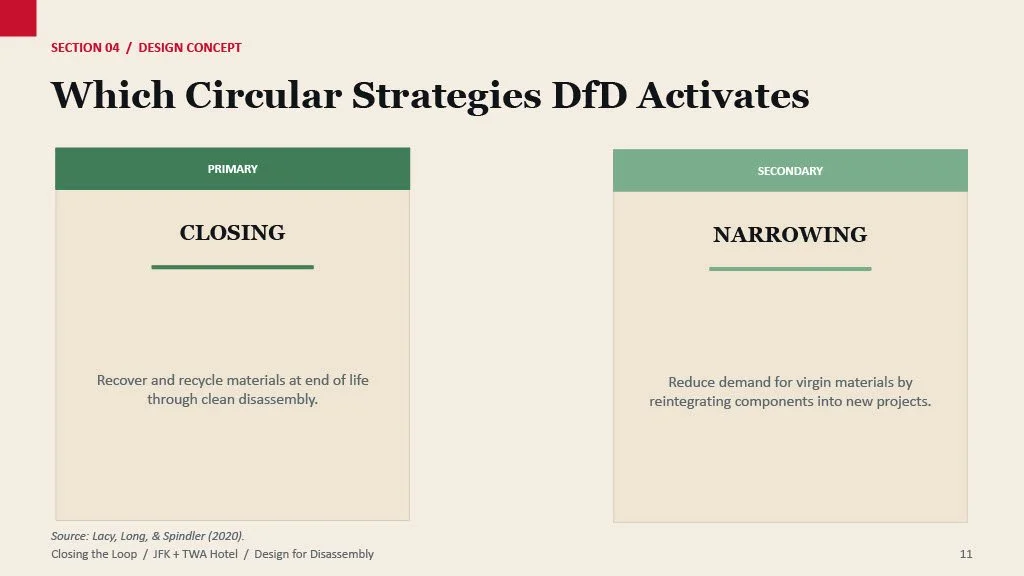
Mapped against circular strategy, the primary move is closing, meaning recovery of materials at end of life through clean disassembly, and narrowing follows because reintegrated components reduce demand for virgin material. Slowing is already active at the TWA Hotel in the adaptive reuse of the Saarinen terminal, and the proposal extends that logic from the shell to the interiors.
Why it can pay
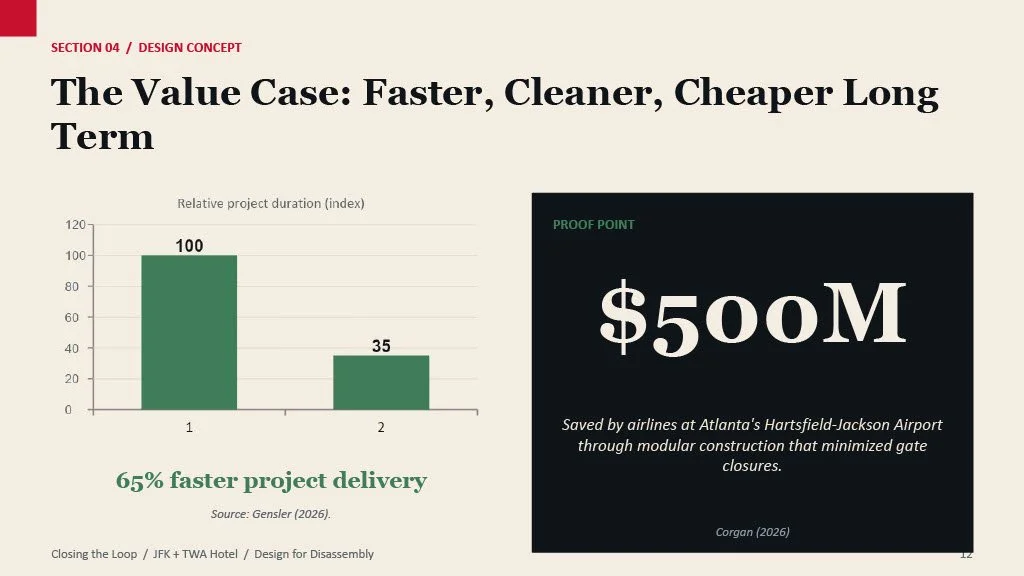
Gensler (2026) puts modular delivery at 65% faster than conventional construction. Corgan (2026) reports $500 million saved by airlines at Atlanta's Hartsfield-Jackson, where modular construction minimized gate closures. At an airport the expensive thing is downtime, and clean disassembly shortens it.
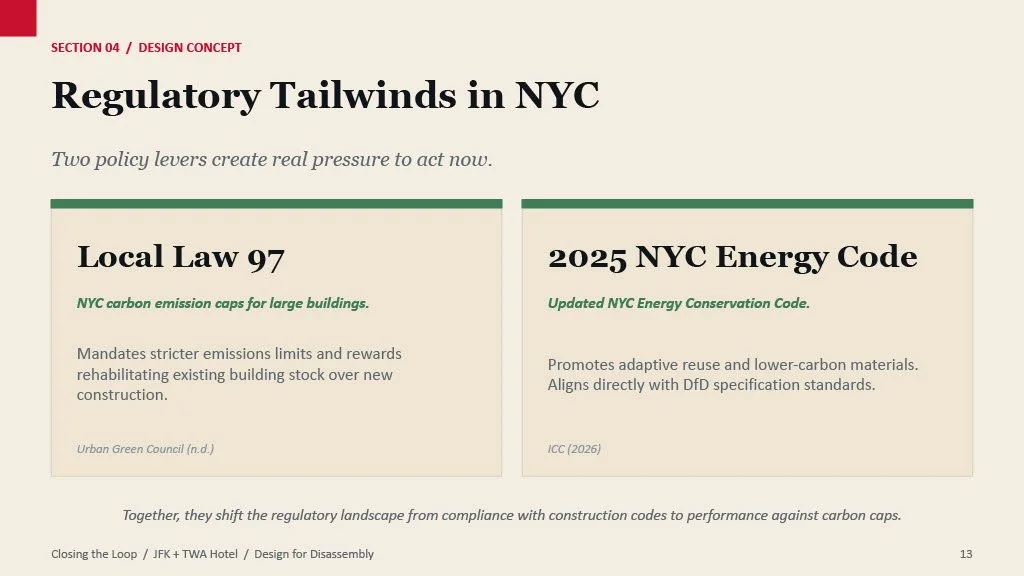
Two policy levers make the timing work. Local Law 97 caps carbon emissions for large New York buildings and rewards rehabilitating existing stock over new construction. The 2025 NYC Energy Code promotes adaptive reuse and lower-carbon material specification. Together they move the question from compliance with construction codes to performance against carbon caps.
How it would run
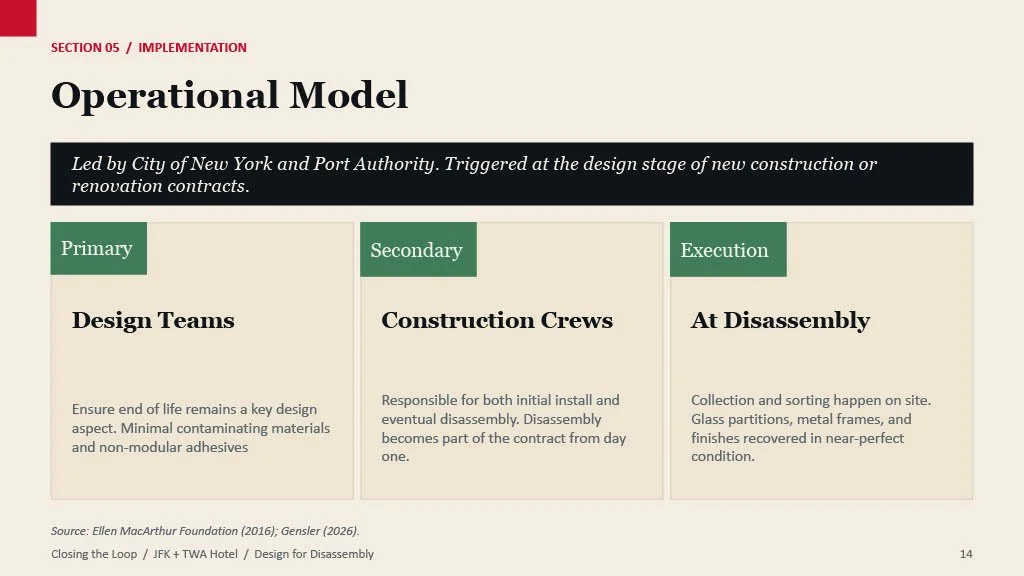
The model is led by the City of New York and the Port Authority and triggered at the design stage of new construction and renovation contracts. Crews responsible for the install are responsible for the eventual disassembly, written into the contract from day one. Collection and sorting happen on site, where glass partitions, metal frames and finishes can be recovered close to intact. Components are cataloged with barcodes and redistributed inside the airport or into the wider New York construction market.
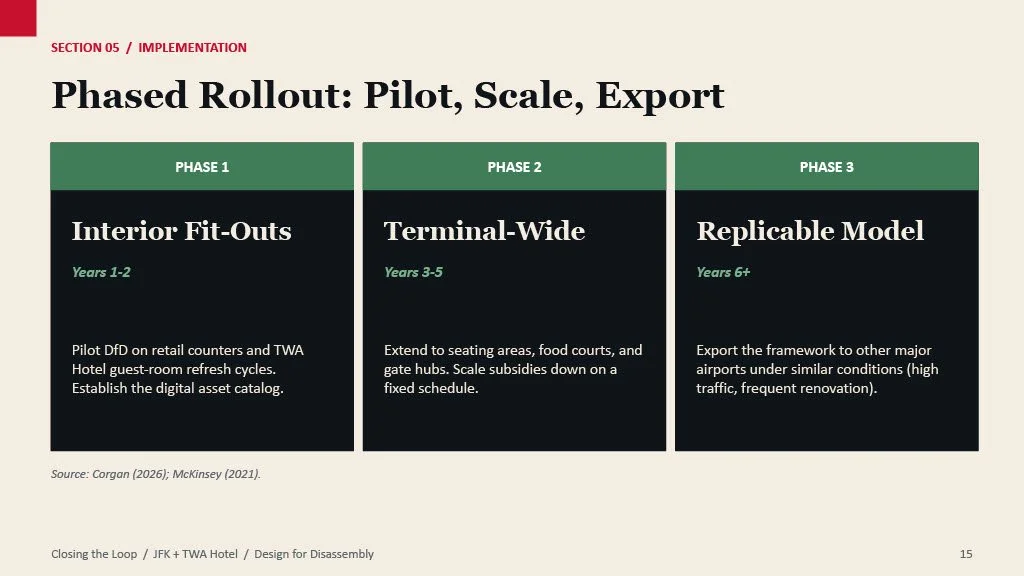
The rollout runs in three phases. Years 1 to 2 pilot on retail counters and TWA Hotel guest room refresh cycles while the digital catalog is built. Years 3 to 5 extend to seating areas, food courts and gate hubs, with subsidies scaling down on a fixed schedule. Years 6 and beyond export the framework to other airports operating under the same conditions of high traffic and frequent renovation.
What could stop it
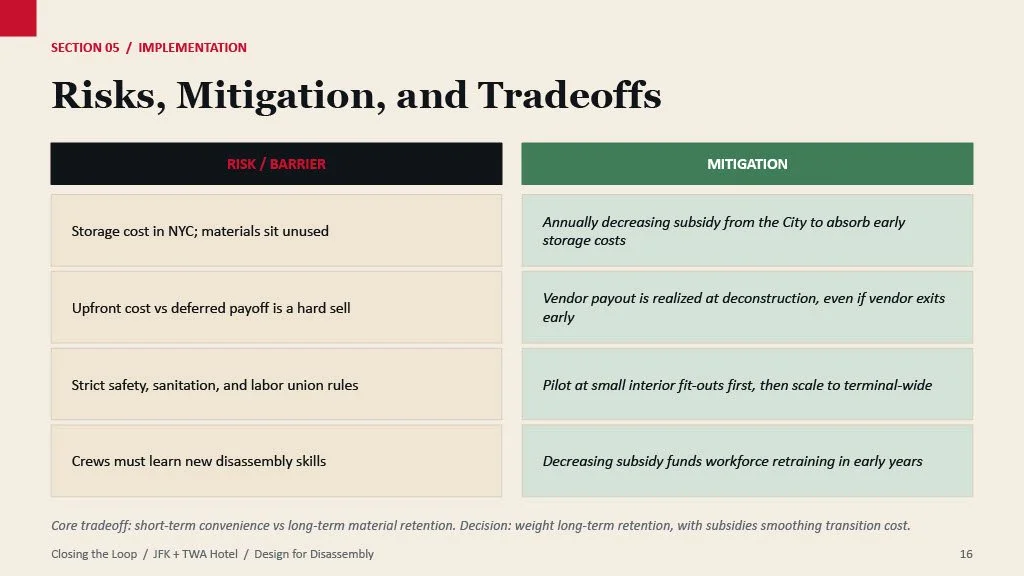
Storage in New York is expensive and recovered material can sit unused, which an annually decreasing city subsidy is designed to absorb. Upfront cost against deferred payoff is a hard sell to a vendor, so the payout is realized at deconstruction even if the vendor has exited the contract by then. Safety, sanitation and labor rules are strict, which is why the pilot starts at small interior fit-outs before anything goes terminal-wide. Crews need disassembly skills they do not currently have, and the same declining subsidy funds the retraining.
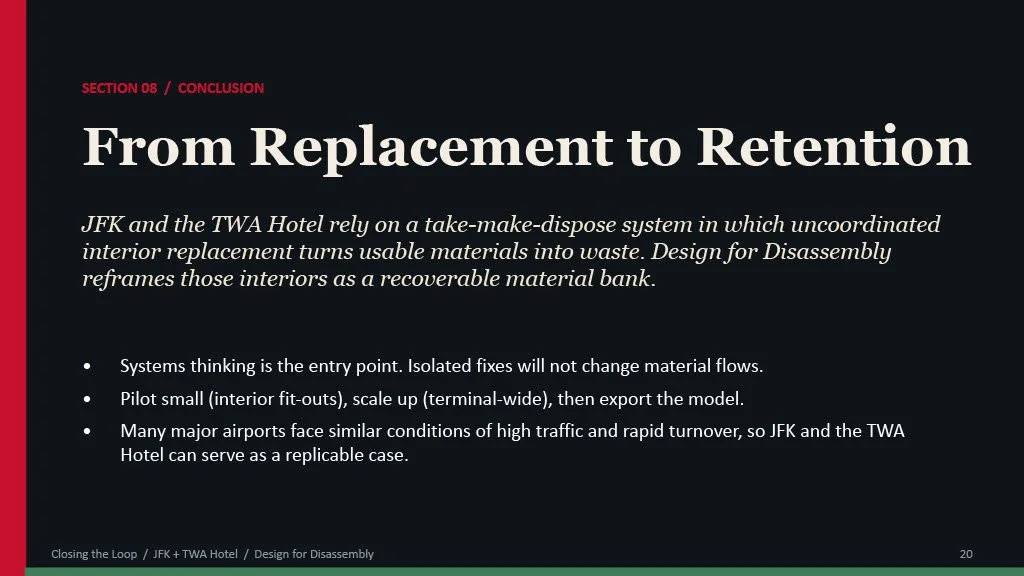
The tradeoff is short-term convenience against long-term material retention. The proposal weights retention, with subsidies smoothing the cost of the transition.
What transfers
Circularity failed here at the system level, not the product level. Every actor at JFK behaves sensibly and the building still discards usable material every few years, which means the fix has to change what the contract asks for, not what the specifier prefers. That is a governance problem before it is a design problem, and it has the same shape in any organization where the person choosing a material is not the person who pays to remove it.
Prepared by Danna Echevarria, Emporia Meng, and Jett Elin
May 2026
Related case studies
Vestas: sustainability across engineering, supply chain and leadership